

Curasan · Synthetic bone graft
CERASORB® M product guide
A purchase-oriented overview of the CERASORB® M configurations currently listed by Whitecap, followed by manufacturer-provided material, structure, indication, and clinical-reference information.
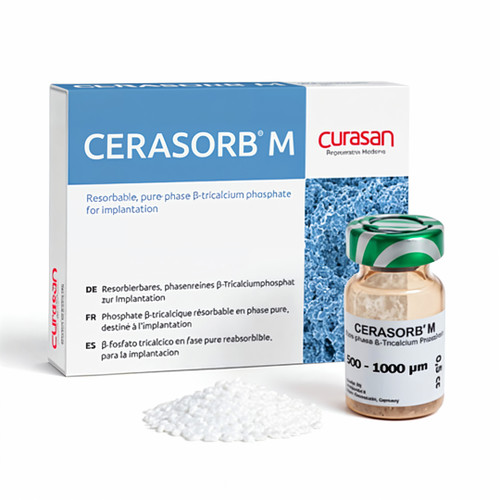
Manufacturer-provided product overview
Resorbable, pure-phase β-tricalcium phosphate
The following product description preserves the key information supplied to Whitecap and identifies it as manufacturer-provided material.
Setting the New Standard for Bone Grafting
CERASORB® M is described by the manufacturer as a biomimetic bone graft with unique interconnected porosity, designed to be resorbed while new bone forms. It is available in multiple granule sizes to address different dental bone-grafting needs.
Manufacturer information describes an interconnected, open multi-porous structure with micro-, meso-, and macropores, approximately 5–500 μm, and an overall porosity of 65%. The polygonal, irregularly shaped granules are designed to intercalate and interlock in the defect cavity, helping limit micromovement that may delay healing.
The current Whitecap selector includes 150–500, 500–1,000, and 1,000–2,000 μm configurations where listed. Always confirm the selected SKU, volume, pack quantity, price, and current instructions for use before ordering.
Multiple Porosities
The manufacturer describes CERASORB® M as combining micro-, meso-, and macropores within an interconnected structure. Its β-TCP particles are designed to interlock and create a material environment intended to support cellular and vascular participation during bone remodeling.
Important: these are manufacturer material-characterization statements, not a guaranteed patient outcome. Product use is subject to the current U.S. label, instructions for use, professional judgment, and applicable law.
Buy the correct configuration
Available five-vial configurations
This table intentionally includes only the five-vial combinations currently shown as selectable on the Whitecap product page.
Whitecap-listed configurations · verify live price and stock in the purchase selector above
| Reference | Granule size | Per vial | Pack |
|---|---|---|---|
| S05-M0150 | 150–500 μm | 0.5 cc | 5 vials |
| S10-M0150 | 150–500 μm | 1.0 cc | 5 vials |
| S20-M0150 | 150–500 μm | 2.0 cc | 5 vials |
| S05-M0500 | 500–1,000 μm | 0.5 cc | 5 vials |
| S10-M0500 | 500–1,000 μm | 1.0 cc | 5 vials |
| S20-M0500 | 500–1,000 μm | 2.0 cc | 5 vials |
| S05-M1000 | 1,000–2,000 μm | 0.5 cc | 5 vials |
| S10-M1000 | 1,000–2,000 μm | 1.0 cc | 5 vials |
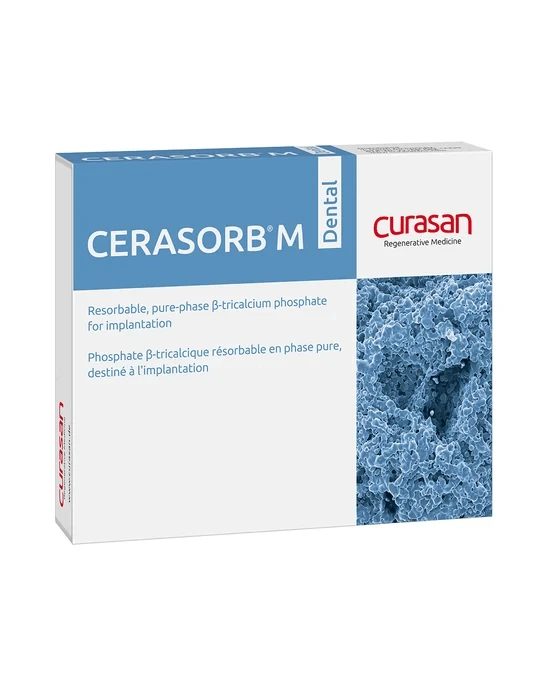
Pack clarity
Every reference in this table is a five-vial box
Choose the granule range and the volume per vial in the native product selector above. The selected price, SKU, stock status, and cart line item should all refer to the same configuration.
- Pack quantity: 5 vials
- Per-vial volume: 0.5 cc, 1.0 cc, or 2.0 cc where listed
- Granule range: 150–500, 500–1,000, or 1,000–2,000 μm where listed
Material architecture
Micro-, meso-, and macroporosity
Manufacturer literature describes how interconnected pore scales can support vascularization and bioactivity within the graft structure.
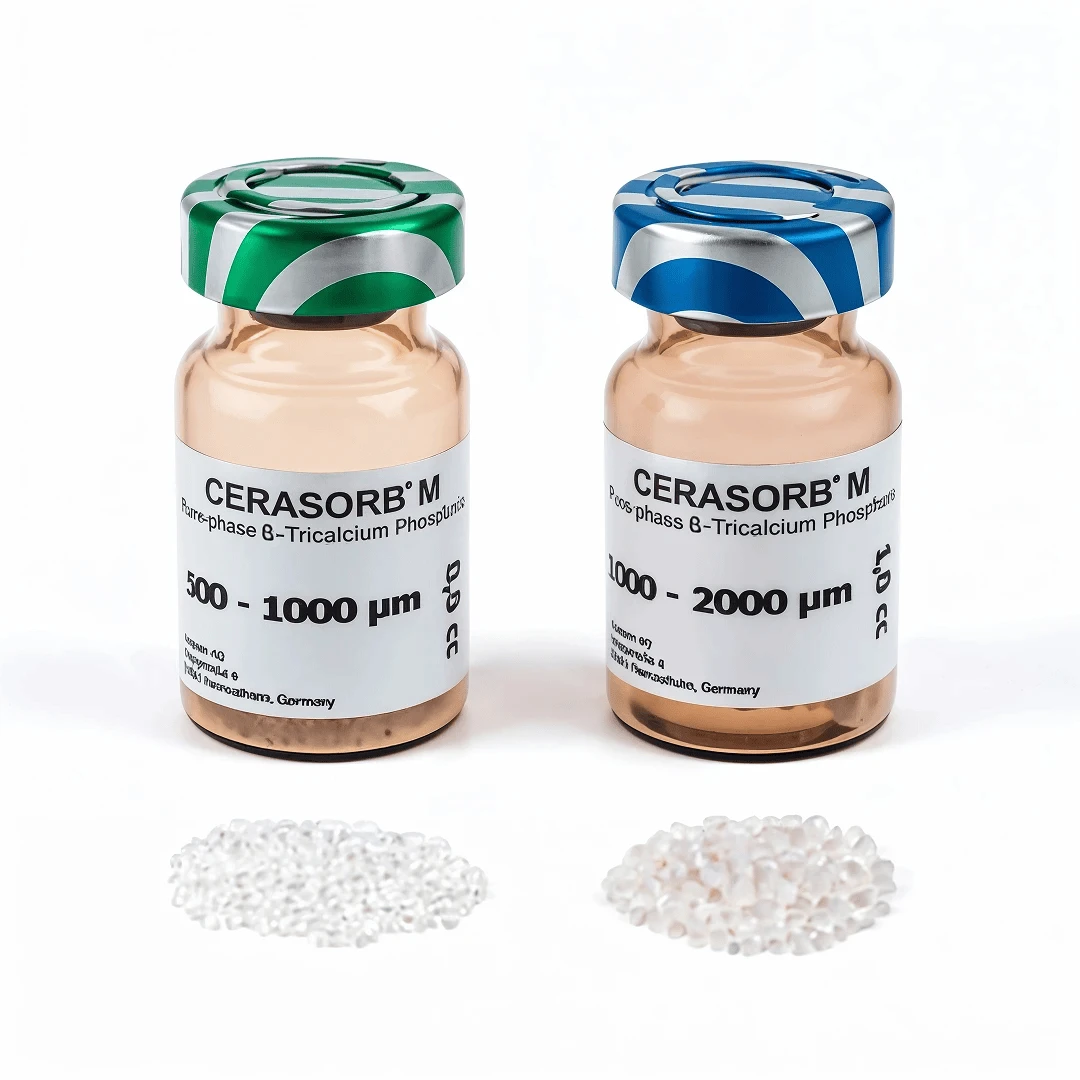
Select by particle range and volume
Granule configurations are separate purchasable references
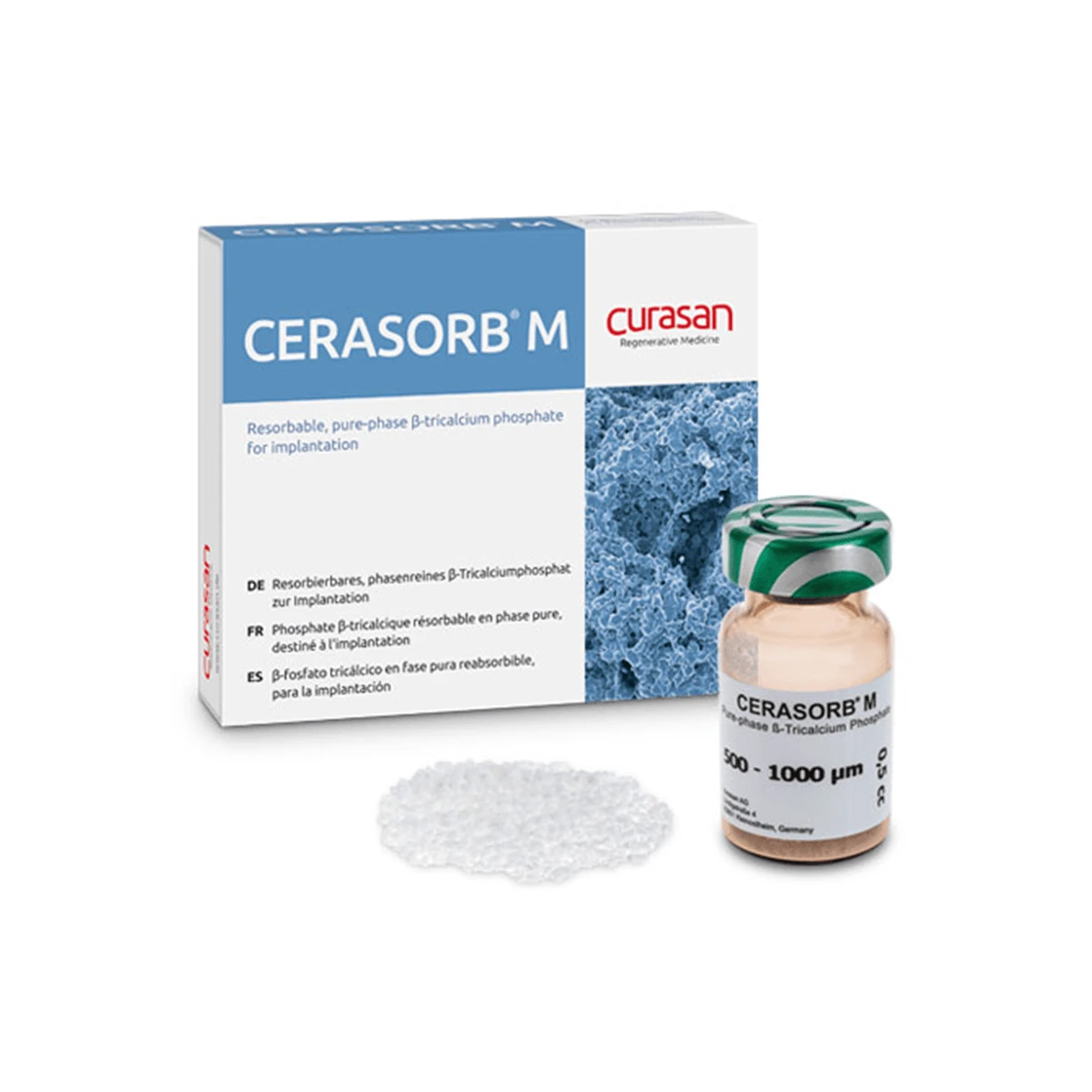
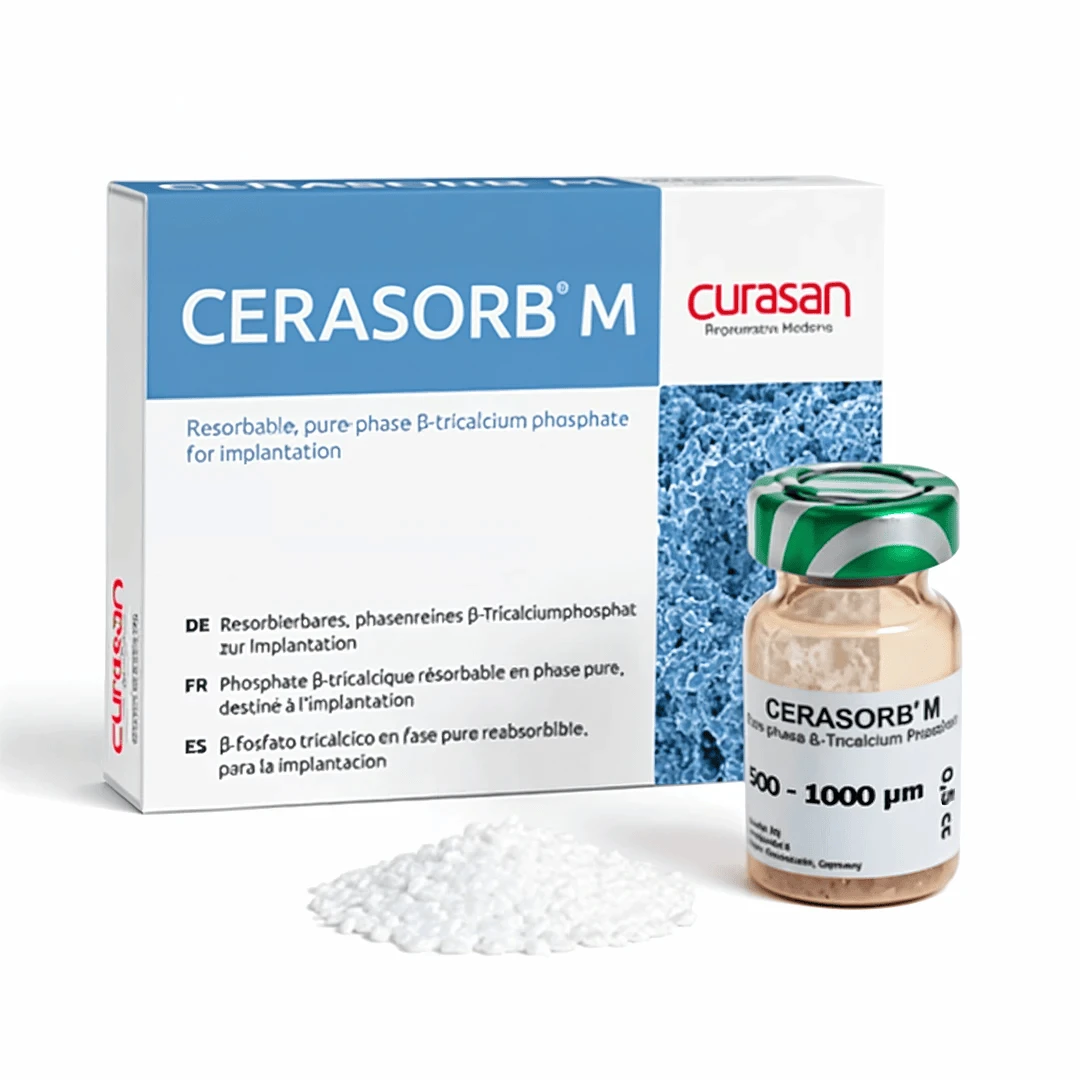
The image illustrates labeled CERASORB® M vials and granule appearance. Use the reference table and live selector—not image color alone—to confirm the exact particle range and volume being ordered.
- Small: 150–500 μm
- Medium: 500–1,000 μm
- Large: 1,000–2,000 μm
At a glance
Features and stated indications
A scannable HTML summary for dental professionals, reconstructed from the supplied manufacturer material.
Features & benefits
- >99% biosynthetic pure-phase β-TCP
- 65% porosity designed for uniform, parallel resorption
- Biomimetic and biodegradable material
- Free of pathogens and proteins
- Radiopaque
- Manufacturer literature describes degradation over approximately 4–6 months
Indications listed by the manufacturer
- Sinus lift
- Alveolar ridge preservation
- Cystic defects
- Socket and ridge preservation
- Periodontal, peri-implant, and intrabony defects
- Guided Tissue Regeneration (GTR) and Guided Bone Regeneration (GBR)
- Implant-bed preparation and osteotomy
The manufacturer describes spaces between interlocking granules as supporting vascularization while limiting micromovement within the defect cavity.
Label controls: this summary does not expand the product indication. Confirm the current U.S. label and instructions for use before ordering or clinical use.
Granule detail
Interconnected multi-porous structure
The manufacturer structure diagram is paired with accessible HTML explanations of the key material characteristics.
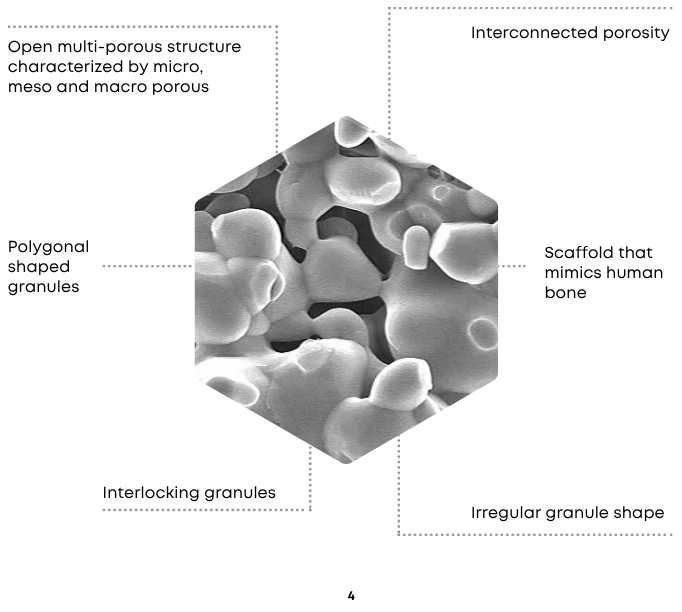
Manufacturer-provided structure illustration; it is not a measurement, patient result, or substitute for current product labeling.
Manufacturer history
Product history and international presence
Manufacturer material describes CERASORB® M as a widely studied product introduced in 1997 and lists markets in which the product has been approved.
Markets listed in the supplied manufacturer material
Regulatory approval and availability can change. This historical list is not a current regulatory-status representation.
Clinical-reference material
Sinus floor elevation reference
The supplied clinical-reference page is converted into a text summary and six-step sequence. Procedural images are available in a clearly labeled, collapsed reference panel.
Reference topic: Sinus floor elevation and its risk.
Authors listed: Dr. Matthias Kebernik and Prof. Dr. Frank Palm, Germany.
Additional supplied study summary: Manufacturer material describes a 10-year comparative implantation study in extraction alveoli augmented with CERASORB® as reporting results comparable with implantation in natural bone. A bilateral sinus-lift study is summarized as suggesting equivalence to autogenous bone in the studied context.
The same supplied material reports handling, efficacy, and healing as generally rated "very good" or "good," with a stated 90% rate for efficacy and tolerance. It also summarizes 22 patients with contralateral intrabony defects treated with CERASORB® alone or with PRP.
The supplied summary states that survival rates did not differ significantly from implants placed in non-augmented bone and cites a 95.7% rate for implants remaining in situ after 9–14 years.
It also states that rough-surface implants had higher success than machined implants and that autogenous bone showed no implant-success advantage over a bone and bone-substitute mixture in the cited context.
- STEP 01Perforation of the Schneiderian membrane
- STEP 02Application of fibrin glue
- STEP 03Closure of the perforation
- STEP 04Augmentation with CERASORB® M
- STEP 05Filled sinus lift
- STEP 06Lateral overlay osteoplasty
View the manufacturer-provided clinical image sequence
Professional and educational reference only. The images depict surgical steps and may be unsuitable for some viewers. They are not procedural training or an instruction for use.
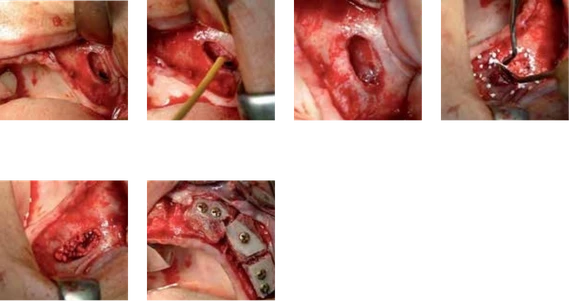
Clinical-reference notice: this is a summary of supplied educational material, not procedural instruction, training, or an outcome guarantee. Review the original cited publication and current IFU.
Professional-use notice: This page summarizes manufacturer-provided educational material and current Whitecap product selections. It does not replace the current product label, instructions for use, contraindications, warnings, or professional clinical judgment.
Product availability, reference numbers, price, and stock should be confirmed in the live selector above before ordering.
WhiteCap product guide
CERASORB M five-vial configurations
A configuration guide for the five-vial CERASORB M options available from WhiteCap.
Confirm before ordering
- Select by the live SKU, particle range and volume per vial.
- Confirm that the cart line matches the chosen configuration.
- Review the current U.S. label and instructions for use.
For professional dental use. Product selection and clinical use remain the responsibility of the licensed clinician.